Catégories
Musique

Soundtracker origins, part 2: Welcome to Turrican, aah hahahaha

Temps de lecture / Reading time : 17 minutes.

It’s high time I write part two of this series of articles on the origins of Soundtracker, since the content itself has been lying in my inbox for well over two years now…

As a reminder: I’ve been writing about my « quest » of looking for the missing link between what seems to be the first « tracker-like » interface1The Page R sequencer, from the Fairlight CMI Series II workstation. At least, according to Wikipedia. and Karsten Obarski’s Ultimate Soundtracker tool, which introduced a cheap tracker interface2Meaning: patterns formed of per-channel columns and single-note rows. But fret not, this loose definition of tracking will soon change. to Amiga musicians back in 1987.


So, where were we?

In part 1 of this series, we learnt more about Karsten Obarski, who became the « Father of the Soundtracker » at age 22. Through existing interviews, we got to understand where he came from, how he came to create his Ultimate Soundtracker tool on Amiga in 1987, why he called it quits a few months afterwards… and where he probably took his inspiration for The Ultimate Soundtracker.
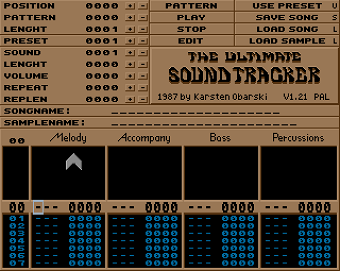
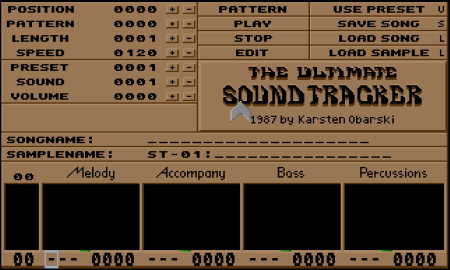
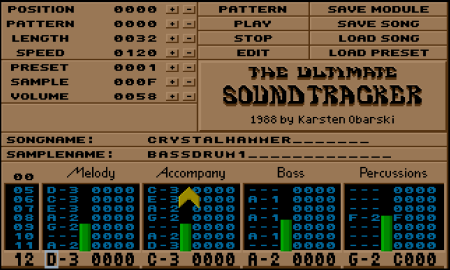
Version 1.21, from December 1987.

Said inspiration was, by all accounts, an earlier tool named Soundmonitor, which German developer & musician Chris Hülsbeck wrote and released on Commodore 64 in 1986 — a year before Obarski’s own Ultimate Soundtracker. Hülsbeck was 18.
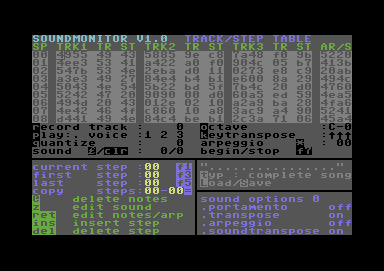
Soundmonitor V1.0
Soundmonitor 1.0, released in October 1986.
I guess kids those days didn’t really need a manual.

Chris Hülsbeck went on to become world-famous by creating game music, not the least being the Turrican series of games3If the title of this article wasn’t enough of a subtle clue already.. He nowadays creates royalty-free music, and oversees orchestral renditions of the Turrican soundtrack, amongst other things. Looking at his Bandcamp page, you could say he keeps himself busy. Buy the vinyls!

Now you know why I chose that title for this article.

So that’s the status of our quest: Soundmonitor seems to have been the original tracker.

Or was it?
Catégories
pas classé

The origin of Soundtracker’s MOD format

Temps de lecture / Reading time : 2 minutes.

NOTE
I did not write this, retro-computing enthusiast Thomas Cherryhomes (owner of irata.online) did, on Twitter in December 23rd 2022 — hence the backdated publication date for this post.

I’m turning his Twitter thread into a proper blogpost because it’s a very informative one for my own research on Karsten Obarski, and I fear that this content might be gone sometimes soon, what with Twitter/X turning into a dumpster fire, and Thomas possibly closing his own account and moving to Mastodon…
Yes, there exist apps such as ThreadReader, but they don’t archive threads, they just display them in a more streamlined way.

Thomas’ thread is reproduced as-is, as closely as possible, with only [minor tweaks] from my part here and there. All credits due to him.


It is commonly said that Karsten Obarski created the MOD format.

Nope.

[Obarski’s Ultimate] SoundTracker saved songs[, not MODs].

The format we know today as MOD evolved very quickly through the efforts of many hackers trying to make an in-house tool better.

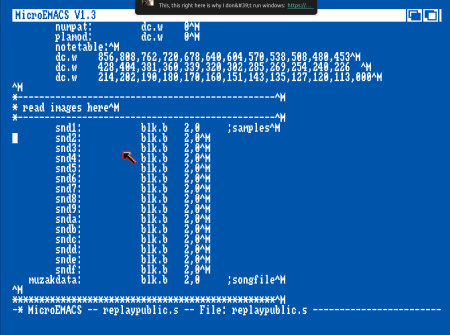
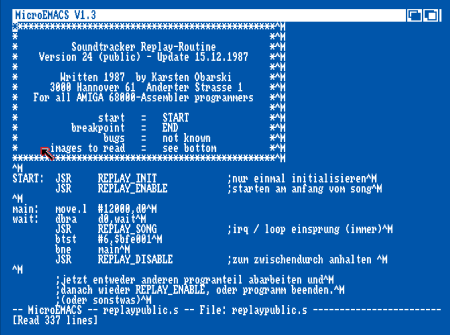
It was expected that once you had a song ready to embed within a game, that you would use the supplied replay routine, and fill in the blanks at the bottom containing pointers to the up to 15 instrument samples you wished to use.

This wasn’t considered a problem, because this was an in-house development tool for game music, and you couldn’t even modify the preset sounds, because they were hard-coded into the program.

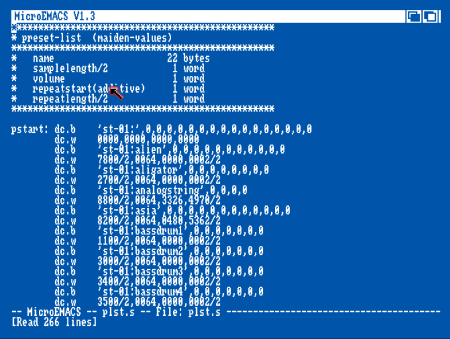
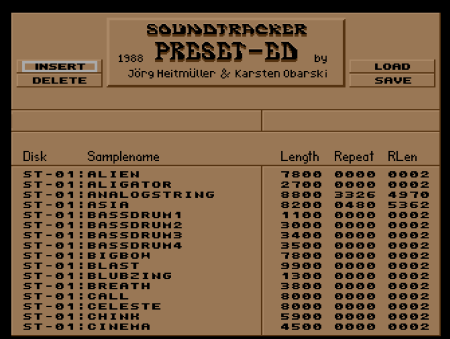
Obi1Nickname of Karsten Obarski. would continue with his original version of Ultimate SoundTracker, eventually splitting out the preset-list to a separate file (PLST), making a source file for it that could be assembled with SEKA-Assembler…

…and providing a separate PRESET-ED tool that could modify the PLST file, thereby allowing a musician to not only have his own presets, but to properly store the important instrument data (length, repeat, replen, etc.), and release it as version 1.8 in April of 1988.

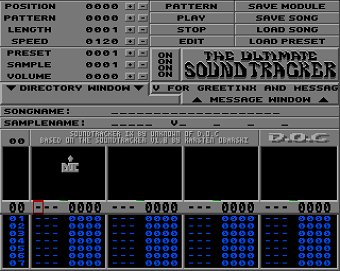
The ability to even SAVE a module didn’t appear until after more than half a year after the cracking groups started disassembling SoundTracker to add features. It appears as early as July 1988 in D.O.C.’s Soundtracker IX, to be used with its replay routine.

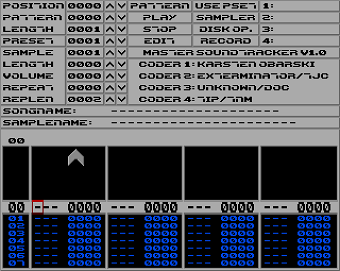
It turns out that July 1988 was a watershed moment for SoundTracker, because The New Masters2« Coder 4: Tip of TNM » in the screenshot below, future author of Oktalyzer. had significantly modified SoundTracker to add module loading (first appearance of Disk Op menu), making the module format sustainable as a self contained music format.

Finally, that October, Obi released UST3Ultimate Soundtracker. version 2.0, it also had the Save Module feature, but no Load Module feature. This would never make it into The Ultimate SoundTracker, as Obi would stop working on the program, and even more would happen in the coming months…

(fin)

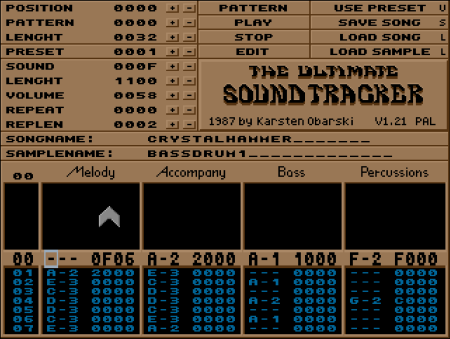
Thomas also produced a comprehensive look at Ultimate Soundtracker 1.21:


Other articles in this series:

  1. Soundtracking sur Amiga : passion, explications et exemples — The Twitter thread that started it all (in French).
  2. Soundtracker origins, part 1: Where in the World is Karsten Obarski? — About Karsten Obarski, author of The Ultimate Soundtracker.
  3. The origin of Soundtracker’s MOD format — When you see a Twitter thread with key information, it is your duty to preserve it.
  4. Soundtracker origins, part 2: Welcome to Turrican, aah hahahaha — About Chris Hülsbeck, author of Soundmonitor.
  5. Soundtracker origins, part 3: Facing a stone mountain — About Karl Steinberg, author of MIDI Multitrack Sequencer.
  6. Soundtracker Origins, interlude: The coders behind the Cambrian explosion — Where I get to interview a few key people in the Soundtracker saga.
Catégories
pas classé

Instafest 2022

Temps de lecture / Reading time : < 1 minute.

En ce temps d’incertitudes envers les plates-formes de publication en ligne, je vais me remettre à publier des contenus courts ici, afin de ne pas faire profiter uniquement Instagram ou Twitter.

Comme chaque année, il y a des applications qui reprennent les données sociales que l’on stocke sans vraiment le savoir, et nous permettent de les mettre en forme.
La dernière en date est Instafest.app, qui crée une affiche de festival à partir des artistes les plus joués dans Spotify sur les 4 dernières semaines, les 6 derniers mois, ou depuis le début — il y a une éternité, en ce qui me concerne.

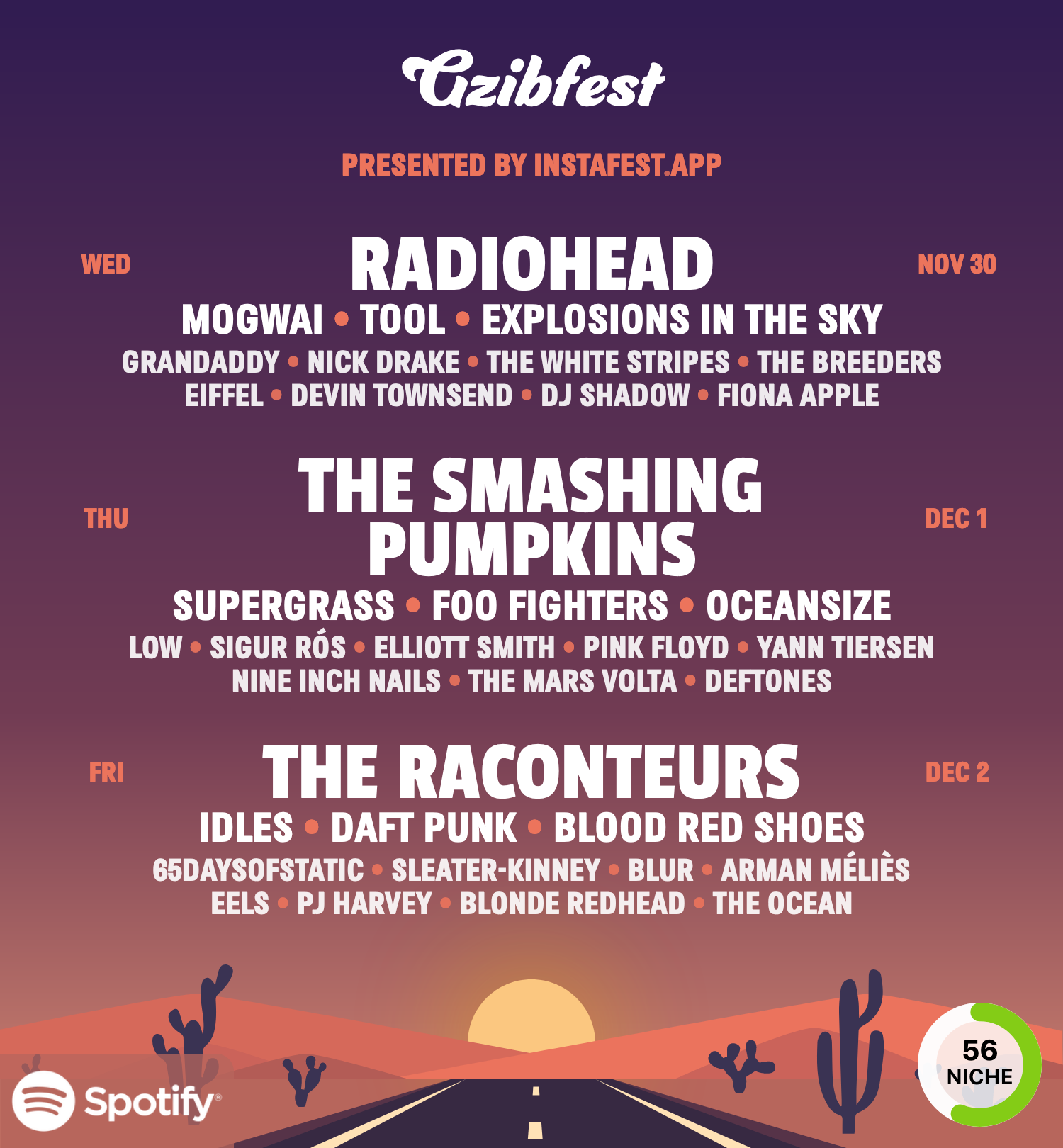
Voici donc mon résultat, pas vraiment surprenant :

Pas vraiment surprenant, donc, car je stocke sciemment ces informations sur Last.fm depuis des lustres — avant même l’éternité de Spotify, donc, d’où la disparité.

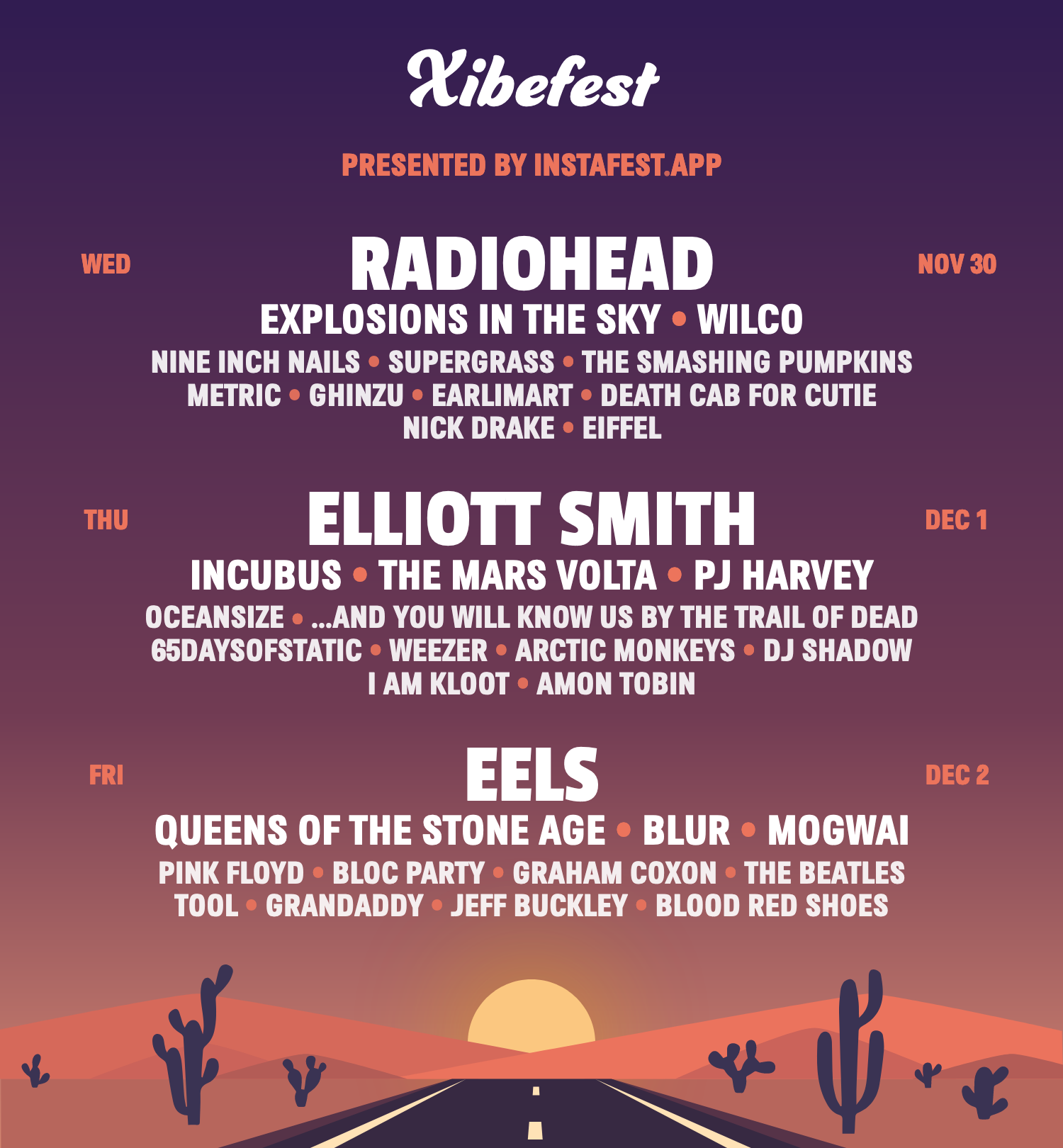
Ah tiens, d’ailleurs on peut aussi le faire avec Last.fm directement. Let’s go:

Publié sur Twitter avec le titre « Je tiens la barre depuis 1997 » (date de sortie d’OK Computer), un mien camarade commenta que je suis « surtout RESTÉ en 1997 », ce qui est très vrai, étant donné que, quand même, 1997 est la meilleure année pour la musique — aucun lien avec le fait que ce soit l’année de mes 20 ans, bien sûr.

Je remercie cependant ces stats de ne pas avoir pris en compte les heures de bruit blanc que j’écoute en boucle lorsque je dois me concentrer…

Catégories
pas classé

Des idées différentes

Temps de lecture / Reading time : 7 minutes.

Avec l’âge, les envies de cadeaux changent. Les raisons sont nombreuses : on a déjà tout ce que l’on veut, on a déjà trop de choses qui attendent que nous nous y consacrions, on n’a plus envie de gros cadeaux qui prennent la poussière…

Terminés les gros trucs qui prennent de la place, les livres qu’on ne terminera jamais, les abonnements qui s’empileront dans un coin, les gift-box qui obligent à réserver un week-end entier à 300 bornes dans 4 mois, etc. Passé un certain cap, on veut quelque chose d’utile immédiatement ou sur la durée, tout en étant quelque chose qui fasse « cadeau ».

Mais que demander au Père Noël ou pour son anniversaire ? Comment guider vers ce qui à la fois fera plaisir et sera utile sur la durée ?

Catégories
Musique

Soundtracker origins, part 1: Where in the World is Karsten Obarski?

Temps de lecture / Reading time : 10 minutes.

Note: Cet article (et les suivants de cette série) sont écrits en anglais, pour la simple raison que mes sources, tant directes qu’en ligne, sont anglophones.
Par ailleurs, dans certains de ces articles, il me semble que j’ajoute du contenu original/rarement vu au corpus de connaissances, donc autant faire en sorte que cela profite au plus grand monde 🙂


My previous article on Soundtracking1In French in ze texte. was all about passion and nostalgia: presenting a couple of great Amiga demos, playing a handful of notable Amiga modules, and explaining my understanding of how soundtracking worked — you know, the whole « notes as a sequence of letters instead of solfege symbols » thing2 Or, « A#3 > 🎶 », which incidentally is the name of Elon Musk & Grimes’ next child.

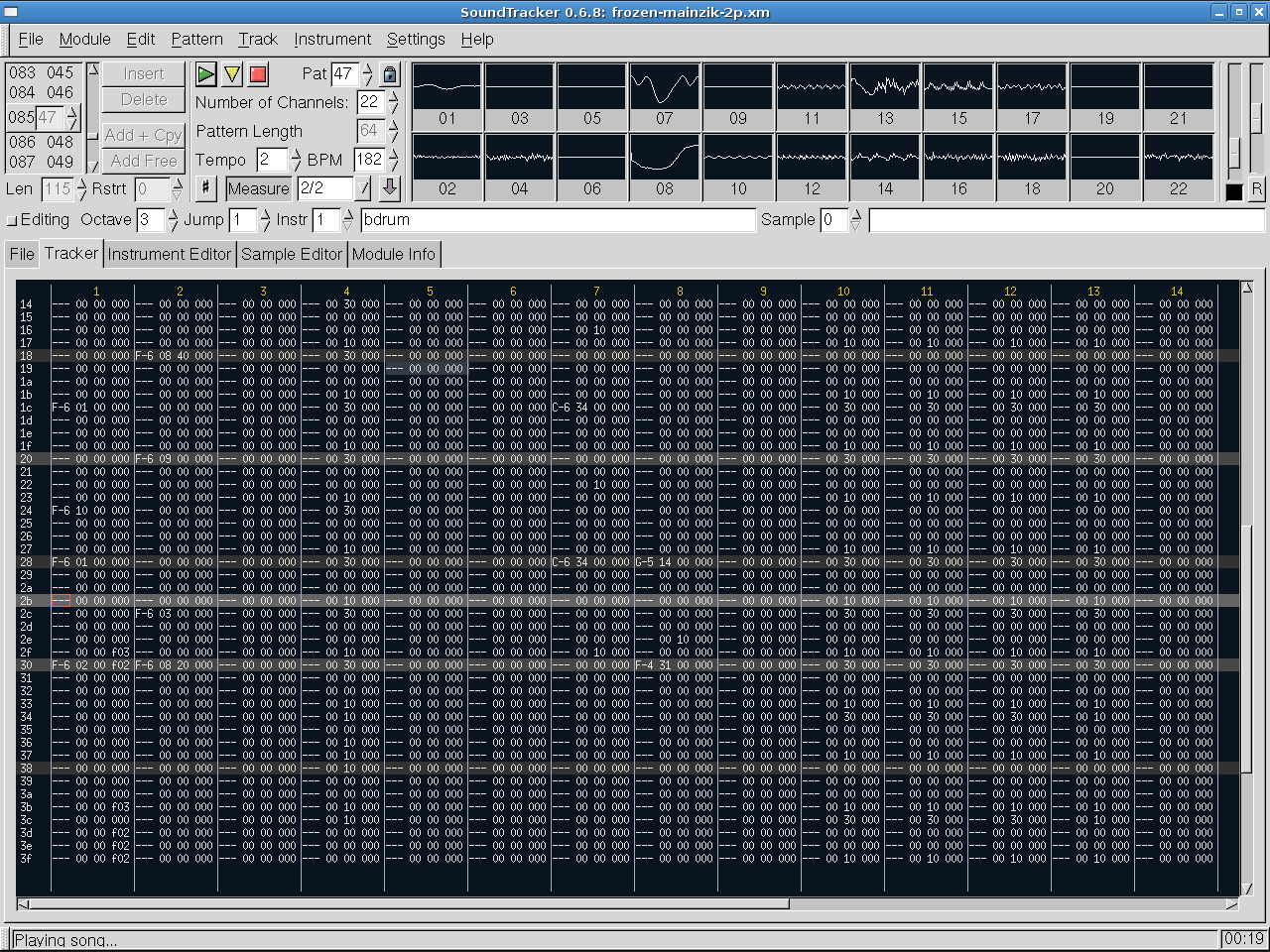
SoundTracker: it’s like writing music with Excel!
This is a Unix version of Soundtracker, from February 2006.
(to hear this specific song, click here and press the Return key)

Today I’m starting a series of articles which is no less about passion and nostalgia, but tries to go further behind the curtains, and talks about the ones who made soundtracking possible: Mr. Obarski of course, but also those who inspired him (and those who, in turn, inspired them3Spoiler alert: It’s turtles all the way down!).

Eventually, my intent is to find out when the « tracker » way of composing music (or, the music sequencer) made the jump from a hardware, physical product to a software product. Who was the first one to dream up coding that interface? Is it really Karsten Obarski, father of the Sountracker? I want to find out.

So let’s start with the culmination of all these inspirations.
Let’s start where this little « quest » of mine started.

(drumroll)